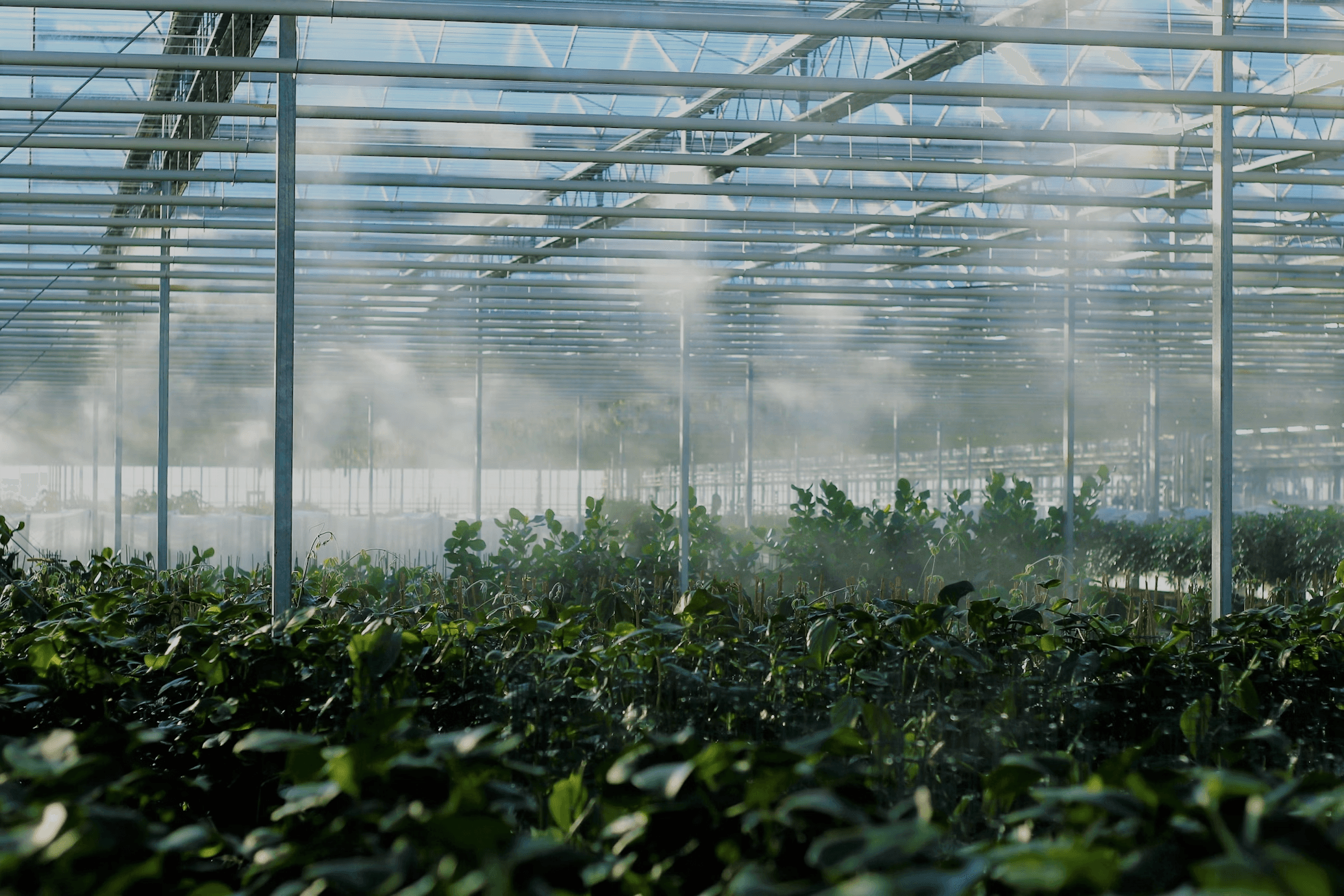

AI Greenhouse Automation
Service:
Custom AI Development, IoT Integration, Full-Stack Web Application Development
Industry:
Agriculture Technology, Smart Farming
Location:
USA
YT Video:


Challenges
Why do greenhouse farms struggle to scale without automation?
Scaling a greenhouse operation is not just a land problem. It is a data problem. As cluster count grows, the number of environmental variables a farm manager must track multiplies exponentially. Temperature, humidity, water flow, CO2 levels, light intensity, pH, oxygen. Each one shifts constantly. Each one affects yield. Managing these manually across even three greenhouse clusters is a full-time job for multiple people. Doing it across ten or twenty is simply not possible without technology.
The client had reached exactly this ceiling. Growth was being throttled not by demand, not by land, but by the sheer operational complexity of keeping each growing environment within optimal range. The team was reactive, not proactive. By the time a human noticed something was off, the crop had already been compromised.
How does inconsistent environmental control affect crop yield and profitability?
The margin for error in controlled-environment agriculture is narrow. A 2-degree temperature swing at the wrong growth stage can reduce yield by double digits. A humidity imbalance creates mould risk. Under-fertilisation stunts growth. Over-fertilisation burns roots and wastes cost. These are not theoretical risks. They are daily realities for farms relying on manual monitoring.
The client was experiencing exactly this kind of inconsistency. Sensor data existed, but it lived in disconnected systems. There was no single source of truth. No intelligent layer to interpret what the numbers meant and act on them before damage occurred. Farm staff were spending hours each day reading dashboards and making manual adjustments, work that was slow, error-prone, and not scalable.
What is the cost of delayed decision-making in precision agriculture?
In precision farming, a delayed decision is a lost decision. If an AI system detects that CO2 levels in a cluster are dropping and adjusts airflow within seconds, yield is protected. If a human detects the same thing 40 minutes later, the damage is already done. At commercial scale, those 40-minute gaps happen dozens of times a day across dozens of clusters. The cumulative yield loss is significant.
Beyond yield, there was a labour cost problem. Skilled agricultural technicians were being used as manual system monitors. Their expertise was being wasted on tasks that should never require human attention. This was expensive and unsustainable, particularly as the client planned to expand.
Why is fragmented sensor data a barrier to intelligent farm management?
Sensors are only as useful as the system interpreting them. The client had invested in hardware, temperature probes, soil sensors, flow meters, light meters. But without a unified platform pulling all of that data into a single intelligent layer, the sensors were generating noise rather than insight. Data points sat in isolation. No correlation. No prediction. No autonomous response.
What the client needed was not more data. They needed a brain sitting on top of the data, one capable of reading every variable simultaneously, predicting what each plant cluster needed next, and acting on that prediction in real time without waiting for a human to approve each decision.
Solution
Unified IoT Sensor Architecture Feeding a Real-Time Intelligence Layer
PrimeSens designed and developed XCore Farm, an end-to-end AI-powered greenhouse management platform that connects directly to the hardware layer and takes autonomous control of the growing environment.
The foundation is a dense sensor network embedded across each greenhouse cluster. Sensors continuously measure:
Temperature inside the greenhouse envelope
Water flow rate to each growing zone
Light intensity across the canopy
Humidity at crop level
Carbon dioxide and oxygen concentrations in the air
Soil pH at root depth
Every sensor reads streams in real time to a centralised cloud database. This is not batch data. It is live data, updated continuously, available to the AI decision engine the moment it is produced. The latency between environmental change and system awareness is near zero.
Predictive AI Engine for Autonomous Resource Control
The intelligence layer is where XCore Farm separates from basic monitoring tools. The AI model does not simply read current conditions. It predicts what each plant cluster will need next based on historical sensor patterns, growth stage data, and environmental trend analysis.
When the model predicts an upcoming resource requirement, it acts. It does not send an alert and wait. It adjusts. Water flow valves open or close. Grow lights dim or intensify. Ventilation systems increase or reduce airflow. Liquid fertiliser dosing is adjusted at the cluster level. All of this happens autonomously, within seconds of the prediction being generated.
This is closed-loop agriculture. The environment changes, the sensor detects it, the AI interprets it, the system responds, and the environment stabilises again. The loop completes without any human in the chain unless an anomaly escalates to alarm status.
Five-Panel Command Dashboard for Full Operational Visibility
Farm owners and managers needed visibility without complexity. XCore Farm's dashboard was built around five core sections, each serving a distinct operational need.
Analytics Panel: Displays all sensor readings and historical trends across resource consumption, soil quality, and crop yield metrics. Farm owners can drill into any cluster, any time window, any variable. The data is presented visually, making pattern recognition fast.
System Activity Log: A chronological record of every decision the AI made and why. Farm managers can review what the system adjusted, at what time, in response to what sensor reading. This creates full auditability and builds trust in the autonomous system over time.
Alarm Centre: Surfaces urgent conditions that require human attention. These are edge cases the AI flags as outside its autonomous authority, extreme readings, hardware faults, or conditions requiring physical on-site intervention. Alarms are prioritised by severity and push notified in real time.
Control Centre: Provides a manual override layer. The farm administrator can take direct control of any greenhouse cluster at any time, adjusting resource supply remotely through the dashboard. This is the safety net that gives operators confidence to trust the AI in its autonomous mode.
Settings Panel: Manages cluster configurations, threshold calibration, sensor assignments, and user permissions across the operation.
Scalable Multi-Cluster Architecture Built for Expansion
The system was architected from day one for horizontal scale. Adding a new greenhouse cluster to the platform is a configuration task, not a development task. New sensors are registered, cluster boundaries are defined in the dashboard, and the AI engine begins monitoring and controlling the new environment immediately.
This design decision was deliberate. The client's growth plan required a platform that would not require re-engineering every time a new cluster came online. XCore Farm supports this natively. The platform grows as the farm grows, without adding operational overhead.
Hardware-to-Cloud Integration Stack
The technical architecture was built to be robust, low-latency, and reliable. Key components include:
Edge processing layer at sensor level to handle local data aggregation and reduce cloud payload
Real-time database using Firebase for sub-second read/write performance across all live sensor feeds
AI/ML model trained on agricultural datasets and fine-tuned on client-specific crop and environment data
RESTful API layer connecting hardware controllers to the cloud brain
React-based web dashboard optimised for both desktop operations and tablet use on the greenhouse floor
Push notification infrastructure for alarm delivery across mobile and desktop
Results
✓ 72% increase in crop volume across monitored greenhouse clusters within two growing seasons of full deployment
✓ 53% reduction in water consumption through AI-controlled irrigation replacing manual and timer-based systems
✓ 34% savings on fertiliser and electricity costs driven by precision dosing and demand-responsive environmental control
✓ Farm managers reduced daily manual monitoring time from approximately 4.5 hours to under 30 minutes per shift, freeing skilled staff for higher-value work
✓ Alarm response time dropped from an average of 42 minutes to under 90 seconds, with critical environmental events now triggering automated corrections before crop damage occurs
✓ The client successfully onboarded 6 new greenhouse clusters onto the platform in the 12 months following launch, with zero additional operations headcount required to manage them
✓ Soil pH deviation events, which were previously detected retrospectively and caused periodic crop losses, were eliminated through continuous real-time monitoring and proactive AI adjustment
✓ The farm owner reported the ability to manage the entire operation remotely for the first time, with full confidence in the system's decision-making during extended off-site periods
If your operation is hitting the ceiling of what manual management can achieve, that ceiling is a signal, not a limit. PrimeSens builds custom AI systems for businesses that are ready to grow past what spreadsheets and gut calls can handle. The right time to start the conversation is before your next season, not after it.
Frequently Asked Questions
What is AI-powered greenhouse automation and how does it work?
AI-powered greenhouse automation uses a network of IoT sensors to continuously measure environmental conditions inside a greenhouse, including temperature, humidity, CO2, light, water flow, and soil pH. The sensor data feeds into an AI model that predicts what each plant cluster needs and autonomously controls actuators to maintain optimal growing conditions. The result is a closed-loop system that manages the environment without requiring constant human input.
How many sensors does a smart greenhouse system typically need?
The number of sensors depends on greenhouse size and crop type. A well-designed system typically deploys sensors measuring at minimum 6 to 8 environmental variables per cluster: temperature, humidity, CO2, O2, light intensity, water flow, soil pH, and nutrient concentration. Larger operations or high-value crops may require additional sensor density. The key is ensuring full-coverage data across the growing environment so the AI has complete situational awareness at all times.
What is the difference between a greenhouse monitoring system and an autonomous control system?
A monitoring system shows you what is happening. An autonomous control system acts on what is happening. Monitoring tools alert a human, who then decides and responds. Autonomous control systems like XCore Farm detect a condition, predict what is needed, and adjust resource delivery within seconds, with no human in the loop unless the event requires physical intervention. For commercial-scale operations, autonomous control is significantly more effective because the response time is measured in seconds rather than minutes or hours.
Can AI greenhouse systems integrate with existing hardware and sensors?
Yes. Most AI greenhouse platforms are designed to work alongside existing sensor hardware through standard communication protocols such as MQTT, Modbus, or REST APIs. The software layer connects to your existing hardware, aggregates the data, and applies the intelligence layer on top. In some cases, older or proprietary hardware may require gateway adapters. A custom development partner can assess hardware compatibility and build the necessary integration layer.
How long does it take to build and deploy a custom agricultural AI system?
A full-stack custom AI greenhouse management platform typically takes between 4 and 9 months to design, develop, and deploy, depending on the number of sensor types, greenhouse clusters, and required dashboard features. Early milestones like MVP dashboards and basic sensor integration can be live within 8 to 12 weeks. Timeline is heavily influenced by hardware readiness and the complexity of the AI model training requirements.
Is it better to buy an off-the-shelf agriculture SaaS product or build a custom system?
Off-the-shelf products work well for standard crops with predictable growing profiles. They are fast to deploy and carry lower upfront cost. Custom systems are worth the investment when your operation has unique crop types, non-standard infrastructure, multi-cluster complexity, or specific integration requirements that commercial products cannot accommodate. Custom systems also give you full ownership of your data, your logic, and your roadmap. For operations planning to scale, that control compounds in value over time.
What return on investment can a greenhouse farm expect from AI automation?
ROI from greenhouse AI automation typically comes from three sources: increased yield volume, reduced resource costs, and reduced labour overhead. Based on implementations in controlled-environment agriculture, farms can expect yield improvements of 40 to 72 percent, water and fertiliser cost reductions of 30 to 55 percent, and significant reduction in daily manual monitoring hours. Payback periods vary by operation size but commonly fall between 18 and 36 months for mid-to-large scale greenhouse businesses.
What technology stack is typically used to build an IoT agricultural platform?
A modern agricultural IoT platform generally combines several technology layers. Hardware sensors communicate using protocols like MQTT or Zigbee. Edge devices aggregate local sensor data before pushing to the cloud. The cloud layer typically uses real-time databases such as Firebase or AWS IoT Core. AI models are built using Python-based frameworks like TensorFlow or PyTorch. The user-facing dashboard is commonly built with React or Vue.js. Notification systems use services like Firebase Cloud Messaging or Twilio. The exact stack depends on scale, latency requirements, and existing infrastructure.
How do farm owners maintain oversight when AI is making autonomous decisions?
Autonomy does not mean opacity. A well-built system provides a full audit trail of every AI decision made, the sensor reading that triggered it, the action taken, and the outcome. Farm owners can review this log at any time. Additionally, all systems should include a manual override layer, allowing the operator to take direct control of any cluster remotely at any point. The Alarm Centre surfaces conditions outside the AI's autonomous authority, ensuring humans remain in control of edge cases and critical events.
What is the first step for a farm business looking to implement AI automation?
The first step is a technology audit and strategy session with an experienced AI development partner. This covers your current sensor infrastructure, data availability, operational workflows, and growth plans. From there, a scoped solution can be designed that matches your budget and timeline. Starting with a pilot on one greenhouse cluster before scaling to the full operation is a common and low-risk approach that produces proof-of-concept results within a single growing cycle.