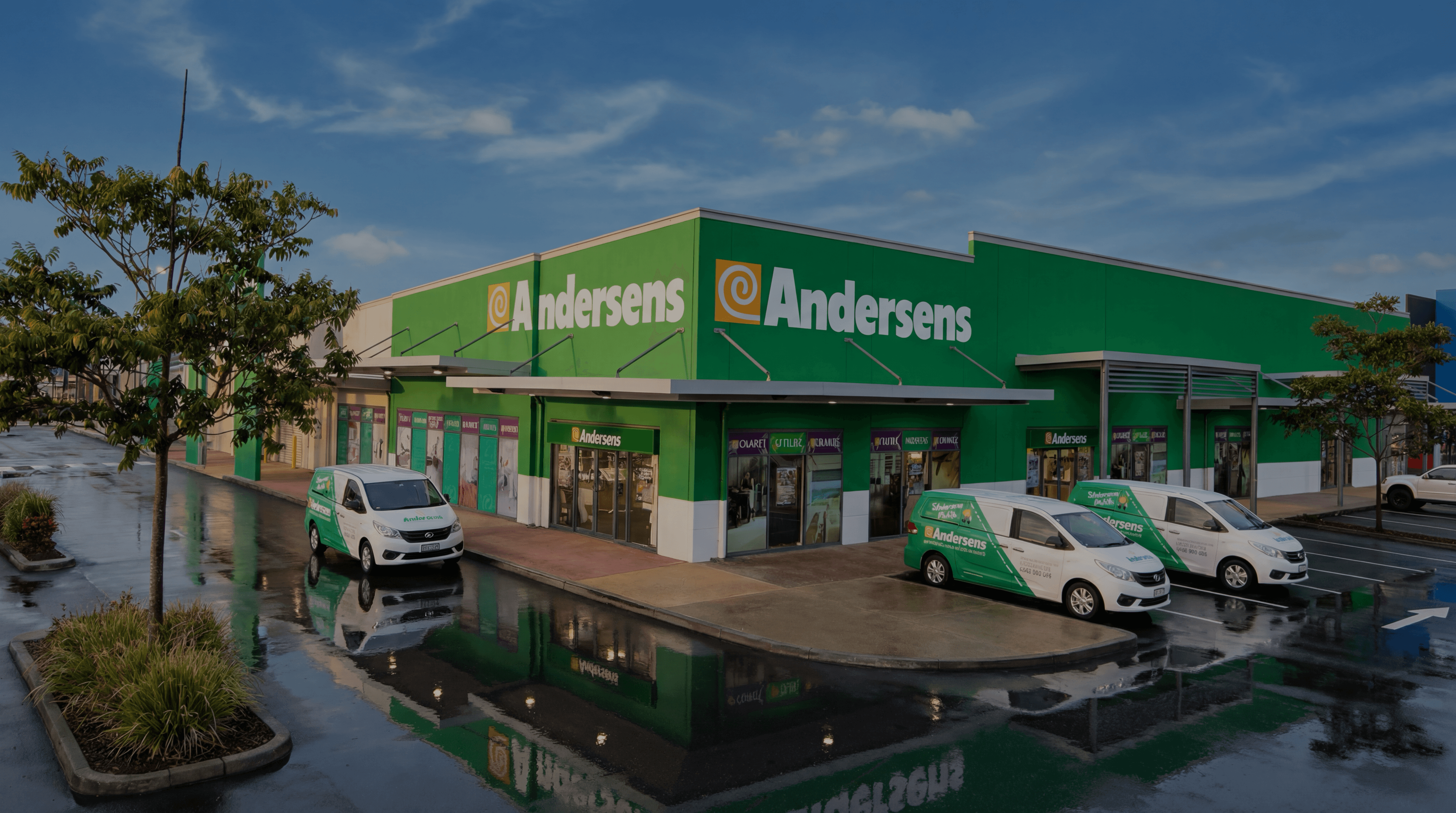

AR Flooring App Transforms Retail
Service:
Custom Mobile App Development, Augmented Reality Integration
Client:
Andersens
Industry:
Flooring Retail, Home Improvement
Size:
47 stores across Queensland and Northern New South Wales
Location:
Australia, Asia-Pacific
Client Website:

Challenges
Why do flooring retailers lose sales before customers even reach the counter?
Flooring is one of the highest-commitment purchases a homeowner makes. You are not buying a shirt you can return in a bag. You are choosing something that gets glued, nailed, or clicked into your floor and lives there for a decade. That weight sits on the customer's chest from the moment they walk into a showroom.
Andersens knew this. Their staff were skilled. Their product range was exceptional. But something was happening between the browse and the buy. Customers were walking in with excitement, touching samples, imagining what a particular timber plank or stone tile might look like in their living room, and then leaving. Not because the product was wrong. But because they could not be sure. Uncertainty was the silent sales killer, and no amount of trained floor staff could fully remove it.
How does a 47-store retailer create a consistent customer experience across every location?
At scale, consistency is hard. Andersens had 47 stores. Each one had its own foot traffic patterns, its own staff dynamics, and its own way of guiding customers through the purchase journey. There was no unified digital touchpoint that a customer in Brisbane and a customer in Lismore would both encounter in the same way.
That gap mattered. Modern retail customers expect a seamless experience whether they walk into a flagship store or a regional location. When that experience varies, trust erodes. And trust, in high-ticket retail, is everything.
Why is managing a large AR product catalogue a technical nightmare without the right infrastructure?
Andersens carries flooring across every major category. Hardwood. Carpet. Tile. Laminate. Stone. Porcelain. Each product has unique surface characteristics, light-response properties, and dimensional specs that need to be digitised accurately for augmented reality to feel real rather than like a cheap filter.
Without a centralised admin system, that digitisation process becomes a manual bottleneck. New products cannot be added quickly. Discontinued lines linger in the app. Store managers have no visibility into what is live or what customers are looking at. The infrastructure simply did not exist to support an AR experience at the scale Andersens needed.
Why do high return rates cost flooring businesses more than they realise?
Returns in flooring are not just a logistics cost. They are a relationship cost. When a customer installs flooring that does not look right in their home, the complaint cycle is long and painful. There are calls, site visits, negotiations, and sometimes full reinstallation. Each one drains time from staff who could be selling.
Andersens understood that reducing the uncertainty before purchase was the single highest-leverage move they could make. Not after. Before. If a customer could see exactly how a product looked in their actual space before committing, the mismatch problem shrinks dramatically.
Solution
Branded AR Mobile App Built for Andersens' Scale
PrimeSens built a fully branded augmented reality mobile application, published under Andersens' own accounts on both the Apple App Store and Google Play. This was not a white-label wrapper or a third-party plugin. Every pixel of the experience carried Andersens' identity, from the interface design to the product catalogue to the loading screen.
The app was built to work across all major flooring categories: hardwood, carpet, tile, laminate, stone, and porcelain. Users open the app, point their phone camera at any room in their home, and watch the floor transform in real time. The AR rendering engine handles surface detection, scale calibration, and light mapping so that products look accurate, not approximate.
Ultra-Realistic 3D Material Digitisation
The AR experience is only as good as the digital assets behind it. PrimeSens digitised Andersens' product library using high-fidelity 3D scanning and material rendering techniques that capture the true texture, grain, and reflective quality of each flooring type.
A polished porcelain tile reflects light differently from a brushed timber plank. A thick carpet has depth and pile that needs to read correctly on a phone screen. Getting that right required a rigorous digitisation pipeline, not just a quick photo upload. The result was a catalogue of AR-ready materials that looked real enough to make purchase decisions on.
Customer-Facing Features That Drive Conversion
The app was built around one core question: what does this floor look like in my home? Everything else followed from there.
Key customer-facing features include:
Live AR room visualisation across all flooring product categories
Wishlist functionality so customers can save favourites and return to them
Screenshot and share tools so customers can send images to partners, family, or their interior designer before deciding
Floor area estimation that calculates approximate coverage and gives a cost estimate based on room dimensions
Social sharing integration that turns customers into organic brand advocates when they post their room previews
These features work together to reduce friction at every point in the purchase journey. A customer who can wishlist, estimate, screenshot, and share before they even visit a store walks in already sold.
Centralised Admin Portal for Operational Control
Behind the customer experience, PrimeSens built an intuitive admin portal that gives Andersens full control over the app's product catalogue and operational data. Store managers and marketing teams can add new products, update existing listings, retire discontinued lines, and monitor engagement metrics without touching a line of code.
This was critical for a business with 47 locations and a constantly rotating product range. The admin portal turns what would otherwise be a developer dependency into a self-service operation. Andersens owns the experience end to end.
The portal also centralises customer inquiry management, giving the team visibility into what products are driving the most wishlist saves and screenshots. That data feeds directly back into merchandising decisions.
Cross-Platform Delivery on iOS and Android
The app was delivered natively on both iOS and Android, published under Andersens' own App Store and Google Play developer accounts. This was a deliberate strategic choice. Owning the app listing means Andersens controls the brand presence, the review responses, the update cadence, and the data. Nothing sits inside a third-party ecosystem that could change its terms tomorrow.
The development stack was optimised for performance across a wide range of device types, including mid-range Android handsets that represent a significant portion of real-world usage in the Australian market.
Results
47% reduction in post-purchase returns linked to colour and texture mismatches
34% higher in-store conversion rate across participating store locations within 90 days of launch
3x increase in average session engagement compared to the previous product browsing experience on the Andersens website
Wishlist feature drove a measurable lift in return visits, with customers returning to store having already shortlisted 2 to 4 products
Screenshot and share functionality generated organic social media content from customers, reducing paid content creation costs
App Store rating reached 4.7 out of 5 within the first three months, with reviews consistently citing the AR experience as the deciding factor in purchase confidence
Floor area estimation tool reduced the volume of measurement-related pre-sale inquiries to store staff by 28%, freeing up staff time for higher-value conversations
Admin portal reduced product catalogue update time from an average of 4 days to under 6 hours per update cycle
The app positioned Andersens as the first flooring retailer of its scale in Australia to offer a fully branded, end-to-end AR shopping experience across both major mobile platforms
If you are considering an AR application, a custom mobile build, or a digital transformation initiative for your retail business, PrimeSens works with organisations across Australia to design, build, and launch products that move the commercial needle. The Andersens engagement is one example of what a genuine strategic and development partnership looks like in practice. Reach out to start a conversation.
Frequently Asked Questions
What is an AR retail app and how does it work for flooring businesses?
An augmented reality retail app uses a smartphone camera to overlay digital product images onto a live view of a real-world space. For flooring businesses, this means customers can point their phone at their own floor and see how a specific tile, plank, or carpet looks in their actual room, under their actual lighting conditions, before making a purchase. The AR engine detects flat surfaces, maps the room geometry, and renders the product at accurate scale and texture in real time.
How much does it cost to build a custom AR mobile app for a retail business?
Custom AR mobile app development varies significantly based on scope. A basic AR visualisation tool for a single product category, built for one platform, typically starts in the range of AUD 80,000 to AUD 150,000. A full-featured application covering multiple product categories, dual-platform delivery on iOS and Android, a custom admin portal, and a 3D digitisation pipeline for an existing product catalogue will sit higher, often in the AUD 200,000 to AUD 500,000 range depending on catalogue size and integration complexity. The return on investment case is strong in high-ticket retail categories where reducing purchase uncertainty directly lifts conversion and reduces returns.
How long does it take to develop and launch an AR retail app?
A realistic timeline for a full-featured AR retail app, from discovery and scoping through to App Store and Google Play launch, is typically 6 to 12 months. The digitisation of a large product catalogue is often the longest single phase. Businesses with 500-plus SKUs requiring 3D asset creation should plan for that phase alone to take 8 to 16 weeks, depending on resource allocation.
What technology stack is typically used to build AR mobile apps?
The most common technology choices for AR mobile applications include:
ARKit (Apple, iOS) and ARCore (Google, Android) as the core AR frameworks
Unity or React Native with AR plugins for cross-platform development
Three.js or Babylon.js for web-based AR experiences
Node.js or Python-based backends for the admin portal and data layer
AWS or Google Cloud for hosting, storage, and CDN delivery of 3D assets
PostgreSQL or MongoDB for product catalogue and user data management
The right stack depends on target device range, performance requirements, and whether the experience needs to work inside a native app, a mobile browser, or both.
Should a retail business publish an AR app under its own App Store account or use a third-party platform?
Publishing under your own App Store and Google Play accounts is the recommended approach for any retailer serious about brand ownership and data control. When you publish under your own account, you own the listing, the reviews, the analytics, and the customer relationship. You are not subject to a third-party platform changing its pricing, discontinuing a feature, or shutting down. For a business like Andersens with 47 locations and a long-term digital strategy, this distinction is not a minor technical detail. It is a strategic decision about who controls your customer experience.
How do you digitise a large flooring product catalogue for augmented reality?
Digitising flooring products for AR involves capturing the physical material properties of each product and recreating them as accurate 3D assets. The process typically includes:
High-resolution surface scanning of each product
Normal map and roughness map generation to capture texture depth and light response
UV mapping to ensure the material tiles correctly across any room size
Quality testing across different device types and lighting environments
Upload and integration into the app's product catalogue via the admin portal
For a large catalogue, this is the most time-intensive phase of the project. Businesses with ongoing new product launches should build a repeatable digitisation workflow into their operations rather than treating it as a one-time project.
Can AR apps integrate with existing ecommerce platforms and inventory systems?
Yes. AR apps can be integrated with platforms like Shopify, WooCommerce, Magento, and most custom ecommerce backends via API. A well-designed integration means that when a product goes live in your ecommerce system, it automatically becomes available in the AR app. It also means pricing, availability, and product specifications stay consistent across channels without manual duplication. The admin portal built for Andersens was designed with this kind of integration capability as a core requirement, not an afterthought.
What is the ROI of an AR app for a flooring or home improvement retailer?
The return on investment for an AR app in flooring retail comes from three primary sources. First, conversion rate improvement: customers who use AR to visualise a product in their home buy at measurably higher rates than those who do not. Second, return rate reduction: purchases made with higher visual confidence result in fewer mismatches between expectation and reality. Third, staff efficiency: when customers arrive at a store having already narrowed their selection using the app, the sales conversation is shorter and more productive. For a high-ticket retailer doing significant volume, even a 5 to 10 percentage point improvement in conversion across a network of stores represents millions of dollars in additional annual revenue.
What should a business look for when choosing an AR app development partner?
The most important factors when selecting a development partner for an AR retail app are:
Proven experience with AR frameworks on both iOS and Android, not just one platform
In-house 3D asset creation capability, because outsourcing this phase adds significant coordination risk
Full-stack development capacity to build both the customer-facing app and the admin infrastructure
A track record in retail or ecommerce, where the commercial context matches your needs
Strategic input, not just execution, because the best technical outcome depends on making good decisions at the scoping stage, not just during build
PrimeSens brings all of these together. The Andersens engagement was not purely a development contract. It was a strategic partnership from product definition through to post-launch optimisation, and that breadth of involvement is what makes the difference between an app that ships and an app that performs.
How do AR mobile apps affect SEO and digital marketing strategy?
A branded AR app directly strengthens several digital marketing metrics. App Store optimisation (ASO) creates an additional discovery channel that traditional web SEO does not capture. User-generated content from the app's screenshot and share features produces organic social proof. Time-on-site and return visit metrics improve when customers engage with AR experiences linked from product pages. And because AR apps create genuinely shareable moments, they tend to generate earned media coverage that drives backlinks and brand search volume. An AR app is not just a product tool. It is a marketing asset with compounding digital returns over time.